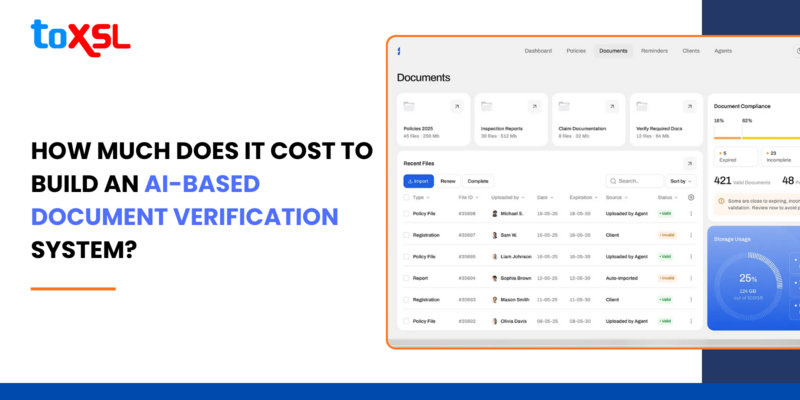
Did you know that an identity theft occurs every 28 seconds in the USA? Consumers reported losing over $12.5 billion to document fraud in 2024. Compared to previous years, the number of people losing money due to these scams has doubled.
Are you worried about getting your business scammed, too? In a world dependent on digital onboarding, remote identity checks, and paperless workflows, worrying about the authenticity of documents is genuine. This has increased the demand for reliable document verification systems.
Key Takeaways:
- AI document verification systems cost $20,000–$100,000+, depending on complexity, data volume, and features.
- Key users include banking, fintech, HR tech, healthcare, logistics, travel, and government.
- Costs vary with features such as real-time checks, multilingual support, cloud architecture, and external database integrations.
- Development typically takes 4–9 months, based on customization and model training.
- Automation can cut costs by up to 70% while improving accuracy.
- Maintenance, scaling, and continuous model updates are crucial for long-term performance.
According to industry reports, businesses now spend billions annually on manual document review, compliance, and fraud prevention. At the same time, fraudsters are getting more sophisticated, using fake IDs, forged passports, and manipulated documents, making traditional manual inspection less efficient.
This is where AI-powered document verification comes into play. By combining machine learning, document layout analysis, and biometric verification, AI systems can verify the authenticity of identity documents. So, if you are a business and deal a lot with documents on a daily basis, having a document verification system is essential.
But how much does it cost to build such a system? What are the hidden expenses? What technologies are involved? And, most importantly, is it worth the investment? And, if you are looking to
develop an AI-powered document verification, what are the necessary steps that you must follow?
Steps to Develop an AI-Powered Document Verification System
Developing an AI-powered document verification system involves several crucial steps to ensure accuracy, security, and compliance:
- Requirement Analysis and Planning: Understand the types of documents to be verified, user workflows, compliance regulations, and core features such as fraud detection.
- Data Collection and Preprocessing: Collect diverse document samples across different types, formats, and languages. Annotate data to train AI models, clearly indicating text regions, fields, and security features. Preprocess images for clarity and consistency.
- Optical Character Recognition Development: OCR converts scanned images or photos into machine-readable text. Choose or develop OCR models customized for various fonts and document designs typical in your use case.
- AI Model Training for Verification: Use machine learning (ML) and deep learning to create models that verify text authenticity, detect document tampering, and flag suspicious patterns. Techniques include image forensics, anomaly detection, and cross-checking metadata.
- Integration with Backend: Connect AI capabilities with backend servers and databases. Build user-friendly interfaces for submitting documents, showing verification status, and managing user data securely.
- Security Implementation: Implement encryption, secure data storage, and access controls. Ensure compliance with local and international laws related to personal data protection.
- Testing and Quality Assurance: Conduct thorough testing for accuracy, speed, edge cases, and security vulnerabilities. Perform user acceptance testing and regulatory compliance audits.
- Deployment and Monitoring: Deploy the system on-premises or on cloud infrastructure. Set up continuous monitoring for performance, potential fraud trends, and model drift necessitating retraining.
How Much Does it Cost to Create an AI-Powered Document Verification System?
The cost to create an AI-powered document verification system can vary significantly depending on multiple factors, ranging from the system's complexity to the resources required. Understanding these cost drivers in detail helps businesses and developers accurately plan budgets and project timelines.
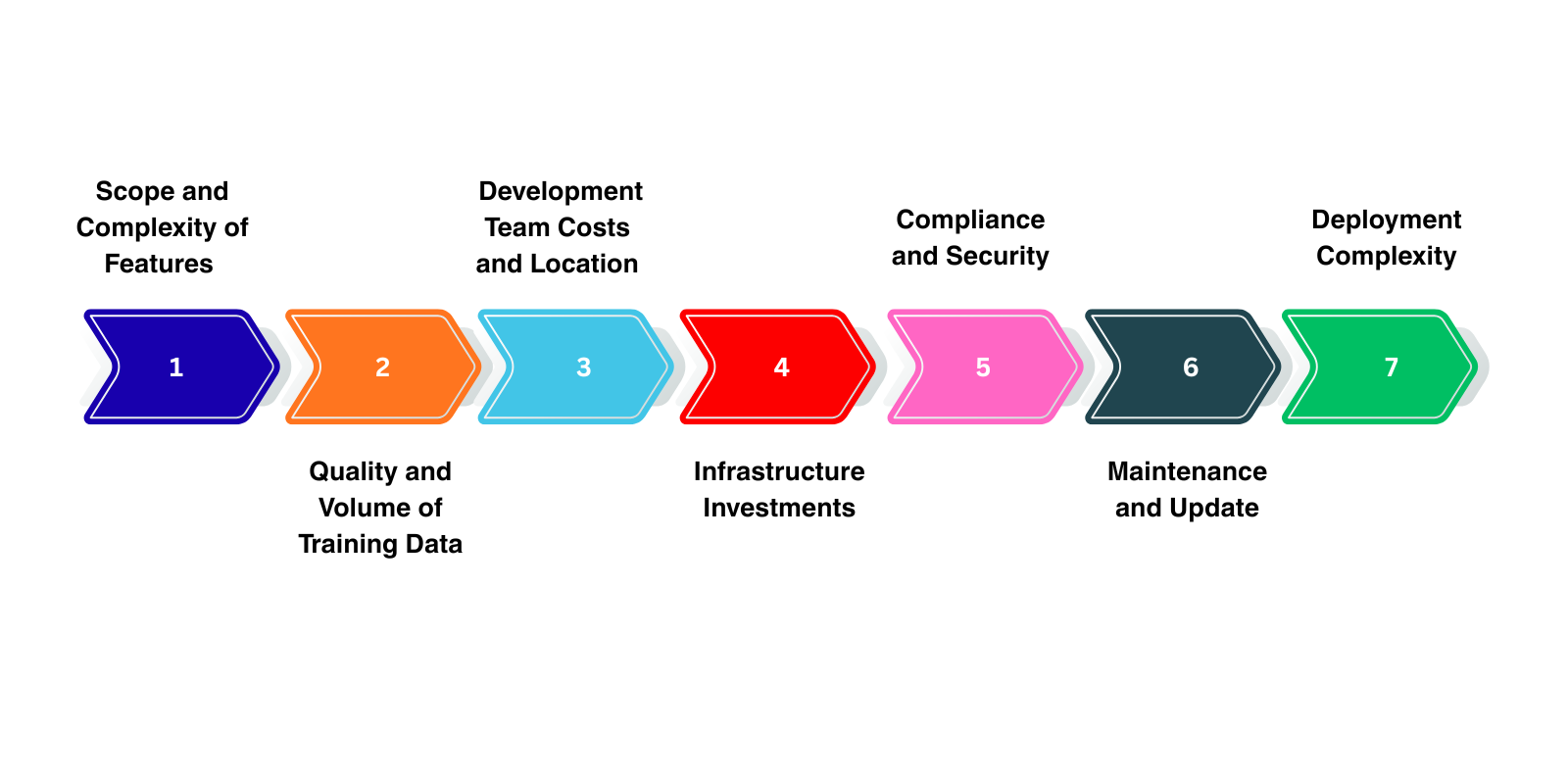
The overall cost generally ranges between $20,000 and $100,000 or more, but this estimate can shift based on several critical components:
1. Scope and Complexity of Features: The range and sophistication of features you want heavily influence the cost. A basic system that solely extracts text via OCR and performs straightforward field verification costs less. However, including advanced capabilities like document forgery detection, biometric liveness checks, or identity matching increases development effort and expense dramatically. For example,
integrating video-based face recognition with the document check requires more computational resources and
specialized AI models, leading to higher costs.
2. Quality and Volume of Training Data: AI model accuracy depends on high-quality, diverse training data. Acquiring a large volume of representative document samples across different formats, countries, and languages can involve licensing fees or extensive in-house collection efforts. Additionally, annotating this data precisely, marking key fields, highlighting security features, and labeling fraudulent examples requires expert human effort, which is both time-consuming and costly.
3. Development Team Costs and Location: Developer rates vary by geography, expertise, and team size. Hiring a top-tier team in North America or Western Europe typically costs more than outsourcing to Eastern Europe or Asia, but may ensure smoother communication and higher-quality outcomes. The size of the team needed also scales with project complexity, encompassing AI specialists, frontend/backend developers, QA engineers, and project managers.
4. Infrastructure Investments: Developing AI models from scratch requires powerful computing infrastructure, often involving GPU servers or cloud instances optimized for machine learning workloads. While cloud platforms like
AWS, Google Cloud, or Azure offer scalable options, the ongoing usage costs add up. Alternatively, subscribing to third-party AI services and OCR APIs can reduce upfront development but incur recurring fees, impacting the total cost over time.
5. Compliance and Security: Because document verification often deals with sensitive personal information, strict compliance requirements like GDPR, HIPAA, or local data protection laws necessitate robust security measures. Implementing secure data storage, encrypted communications, audit trails, and privacy controls drives additional development time and legal consultation costs.
6. Maintenance and Update: AI-powered systems are not one-time builds; they require ongoing maintenance. Document formats and fraud techniques evolve, necessitating periodic updates and retraining of AI models. This maintenance phase includes fixing bugs, refining algorithms, monitoring system performance, and adapting to regulatory changes, all of which contribute to recurring operational expenses.
7. Deployment Complexity: Integrating the verification system into existing workflows, user applications, or backend platforms can add costs related to custom APIs, middleware, or user interface design. Deployment choices, whether on-premises, cloud-based, or hybrid, also affect setup and operational expenditure.
Cost Component | Description | Estimated Cost Range |
Requirement Analysis and Planning | Understanding project needs, compliance, and feature scope | $3,000 – $5,000 |
Data Collection & Annotation | Gathering diverse document samples and precise labeling | $5,000 – $10,000 |
AI Model Development | Building OCR, fraud detection, and verification AI models | $10,000 – $50,000 |
Frontend & Backend Development | Developing user interfaces and backend systems | $30,000 – $80,000 |
Security & Compliance | Implementing encryption, secure data protocols, and legal compliance | $5,000 – $10,000 |
Testing & Quality Assurance | System testing, bug fixes, user acceptance, and regulatory checks | $7,000 – $10,000 |
Deployment | Infrastructure setup and system rollout | Included with testing/deployment or $5,000 – $20,000 if separate |
Ongoing Maintenance & Updates | Model retraining, system upgrades, and operational support | $10,000 – $20,000 annually |
Technologies Behind an AI-Powered Document Verification System
Authenticating documents is not an easy process. There are a lot of technologies behind the development of an AI-powered document verification system. Let us have a look at them:
1. Optical Character Recognition (OCR): OCR is the foundation of AI document verification systems. It enables converting printed or handwritten text into machine-readable data.
Traditional OCR Engines
AI-Enhanced OCR
- Uses convolutional neural networks
- Handles complex backgrounds, blur, low resolution, and handwriting
Cloud OCR APIs
2. Machine Learning (ML): ML algorithms enable classification and pattern recognition across document types.
- Random Forest
- Logistic Regression
- SVM (Support Vector Machines)
- Gradient Boosting
- Naive Bayes
3. Deep Learning: Deep learning enhances OCR and computer vision capabilities, making document verification far more accurate and robust.
4. Computer Vision
Computer vision (CV) gives the system the ability to “see” and understand visual elements of a document.
5. Natural Language Processing: NLP helps the system understand and validate the content extracted by OCR.
- BERT
- RoBERTa
- GPT-based transformers
- SpaCy
- NLTK
9. Cloud Computing and Infrastructure Technologies
Modern document verification systems rely heavily on scalable cloud infrastructure.
- AWS (Textract, Rekognition)
- Google Cloud Vision
- Microsoft Azure Cognitive Services
10. API Integrations
APIs enable seamless integration with banking apps, KYC platforms, HR onboarding systems, insurance portals, and travel booking apps. However, Microservices architecture ensures scalability, allows modular deployment, improves fault tolerance, and reduces deployment risks.
11. Security Technologies
Document verification involves sensitive data, so strong security measures are essential.
- AES and RSA encryption
- SSL/TLS
- Role-based access control (RBAC)
- JWT authentication
- GDPR, HIPAA, and SOC compliance
Conclusion
As industries continue to grow at a rapid pace, the demand for secure, scalable, and intelligent verification systems will only grow.
ToXSL Technologies stands at the forefront of this digital transformation. With deep expertise in AI,
machine learning, OCR, computer vision, and custom software development, ToXSL delivers end-to-end document verification solutions. Our team builds systems that process documents in seconds, reduce operational costs, and deliver unmatched accuracy through next-generation AI algorithms.
Whether you need a full-scale verification platform, API integrations, real-time face matching, or custom AI models, ToXSL Technologies provides the expertise, technology, and support necessary to build a future-ready system.
We focus on quality, security, and continuous innovation, ensuring that your business stays compliant, competitive, and protected against evolving fraud threats. If you are ready to automate document verification with cutting-edge AI, ToXSL Technologies is here to help. Contact us to learn more.
Frequently Asked Questions
1. What is an AI-powered document verification system?
An AI-powered document verification system uses technologies like OCR, machine learning, computer vision, and NLP to automatically authenticate documents. It extracts information, checks for tampering, validates data fields, and ensures that documents such as IDs, passports, statements, or certificates are genuine and compliant.
2. Which industries benefit the most from AI-based document verification?
Industries such as banking, fintech, insurance, HR, real estate, healthcare, travel, logistics, and government services benefit significantly. These systems reduce manual effort, prevent fraud, and streamline onboarding or compliance workflows.
3. Can AI detect forged or tampered documents?
Yes. With
deep learning and
computer vision algorithms, AI can identify inconsistencies such as altered text, mismatched fonts, photo editing, missing watermarks, and other signs of manipulation that human reviewers may miss.
4. How accurate are AI-based document verification systems?
Modern AI models can achieve 95–99% accuracy, depending on document quality, dataset size, and the diversity of training data. Accuracy improves over time as the system processes more documents and learns from new patterns.
5. How long does it take to develop a custom document verification solution?
Development can take 4 to 9 months, depending on complexity, number of document types,
AI model requirements, integrations, and security features. ToXSL Technologies builds scalable solutions tailored to business needs and timelines.
6. What technologies are used in AI-powered document verification?
These systems use a combination of OCR, machine learning, computer vision, deep learning, NLP, liveness detection, biometrics, and cloud infrastructure. Together, they enable fast, accurate, and fraud-resistant verification.
7. Why choose ToXSL Technologies for building my document verification system?
ToXSL Technologies offers deep expertise in
AI/ML development, OCR solutions, computer vision modeling, and integration engineering. We deliver secure, scalable, and fully customized document verification platforms designed to reduce operational costs, boost efficiency, and protect your business from fraud.